search

 In these weeks following Easter, we are learning alongside our church school students how the good news of Jesus’ resurrection begins to spread. As more and more see the risen Messiah, their doubt changes to belief and they share the story of Resurrection. Through the faithful service of disciples, those who are least likely, come to follow in the hope of Jesus’ ministry and teachings.
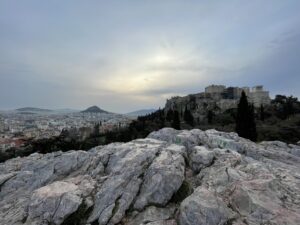
During my 2022 sabbatical, I made a point to visit the Areopagus (Greek for “Ares’ Hill” also called “Mars Hill”) in Athens, because I remembered hearing about it growing up in Sunday School. I was happy to find it on my own on a sunrise walk around the Acropolis, quietly unpopulated by other tourists (see my photo to the right), and have a prayerful moment of thanks for the legacy of the place, for my sabbatical, for our community.
It was on this site that the newly minted Christian Evangelist Paul took on the learned Athenians in a thoughtful religious discourse (Acts 17:16-31). In short, while being sized up and ridiculed by the Athenians, Paul flips the script and tells them that among all their homage to the gods, he’d noticed an altar to “an unknown God,” and he’s ready to tell them about this God. I’ve always admired his rhetorical nimbleness in this moment, his ability to engage people who would easily dismiss him, and begin a thoughtful and thought-provoking conversation.
While many of us would be hard-pressed to match Paul’s zeal and single-minded certainty about doctrine, I do wonder what are our own “unknown God” moments. How much do we practice a way of being Christian that might seem foreign, unimaginable or unknown to those right around us? What Gospel do you and I preach and how do we do it?
On Sunday, I want to delve into these questions with you.
In faith,
Kent
Image by Kent French, taken from the Areopagus, looking toward Acropolis (right) and Lycabettus (left). March 29, 2022.